For the first two years of the commercial Large Language Model (LLM) era, developers enjoyed a predictable trend: continuous, aggressive price deflation. Each new generation of models brought higher intelligence alongside double-digit price cuts.
But over the last six months (late 2025 to mid-2026), that trend has ground to a halt. In its place, a new reality has emerged: capability-driven inflation. For the first time, Western providers like OpenAI, Google, and Anthropic are launching newer models at significantly higher price points to offset the immense compute demands of agentic reasoning.
In this post, we’ll explore the data behind this pricing reversal, look at the transition across tiers, and discuss how to navigate these rising costs on managed infrastructure.
Interactive Timeline: Watch the Price Reversal in Action
Watch this animated bar-chart race showing how the prices of these model families shifted month-over-month from March 2023 to May 2026:
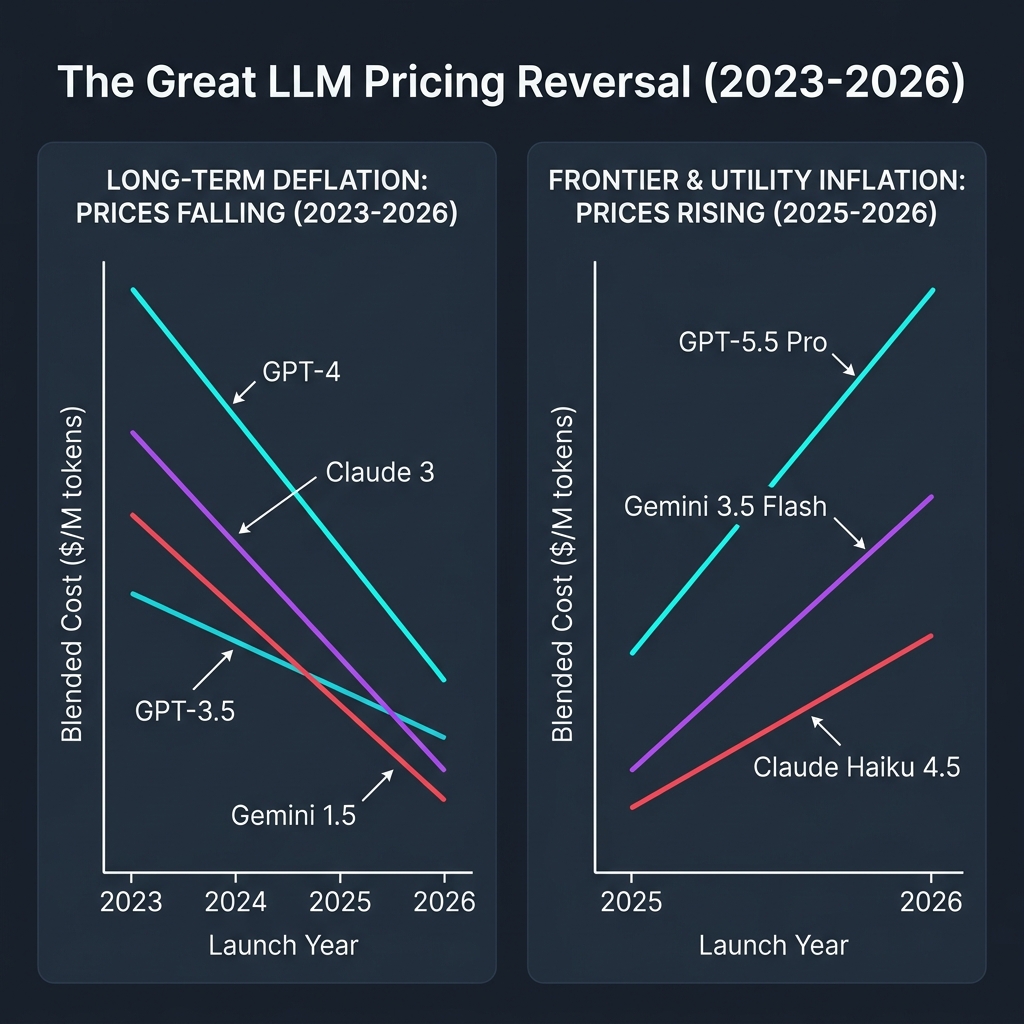
The video clearly illustrates the "Plunge" phase where all models dropped in price, followed by the "Split" in early 2026 where the lines for new model releases shot straight back to the top of the chart.
📊 Data Sourcing Reference: All pricing data is sourced from the open-source pydantic/genai-prices catalog, which tracks public API pricing across model generations, combined with official model release press releases for launch date validations.
The Historical Baseline: The Era of Deflation (2023 – 2025)
Before late 2025, the market narrative was all about the race to the bottom. Here is how prices declined from early 2023 flagships to the mid-2025 baseline:
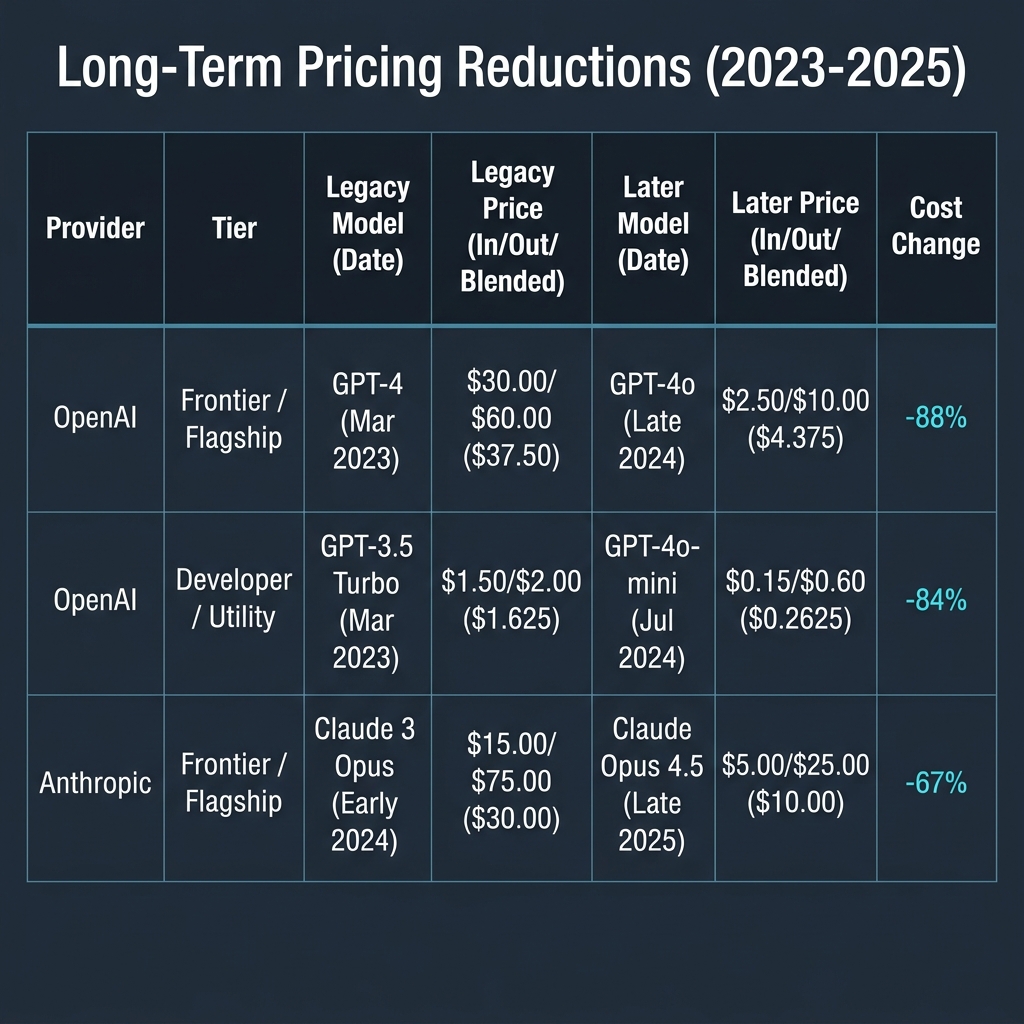
This steep deflationary drop allowed developers to build prototypes cheaply, but it also set unrealistic expectations for the cost of next-generation intelligence.
The Great Reversal: 6-Month Trends (Nov 2025 – May 2026)
Over the last 6 months, we have witnessed a sharp correction. Rather than prices continuing to decline, we are seeing Frontier Premium Inflation and Utility-Tier Inflation across the board:
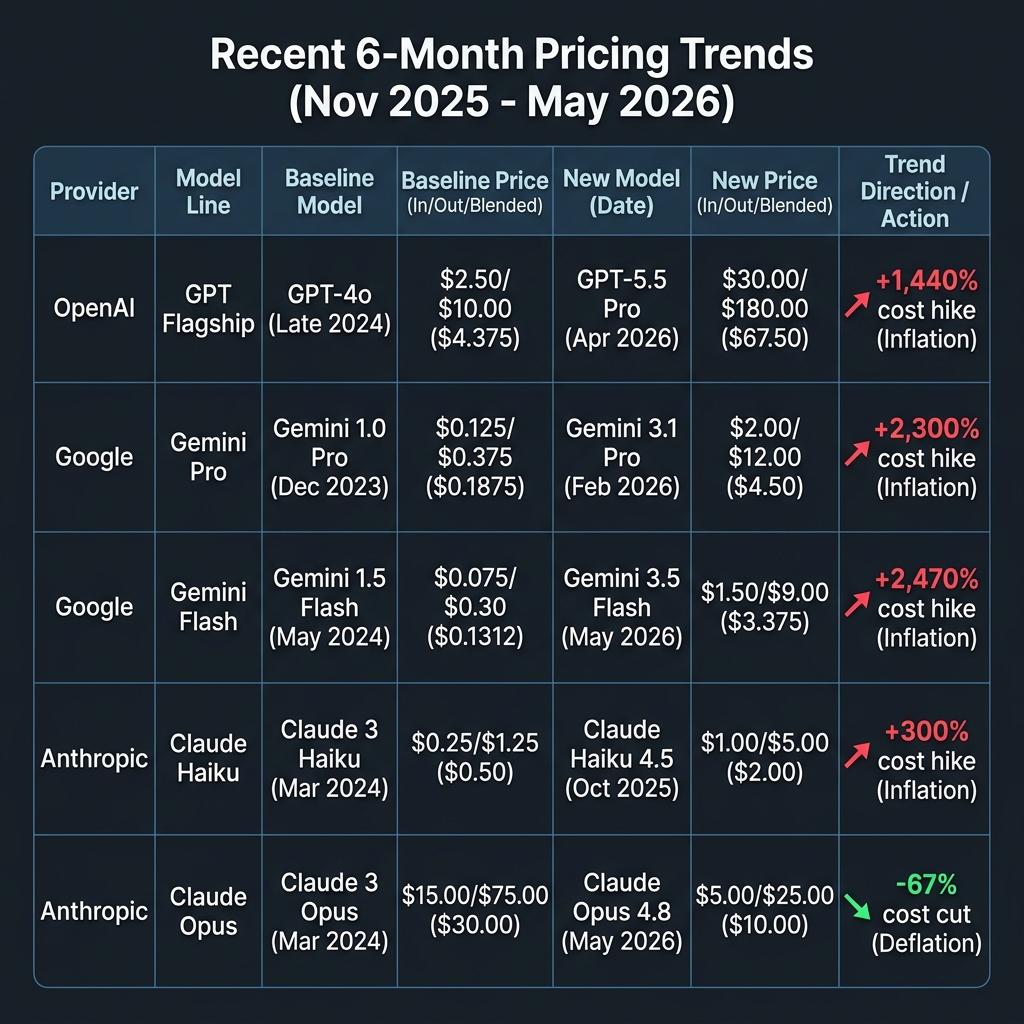
To help visualize this dramatic shift, look at the trend breakdown below:
The Drivers of Inflation:
- Frontier Premium Inflation: As reasoning models push boundaries, compute demands are skyrocketing. OpenAI's GPT-5.5 Pro returned flagship costs back to 2023 levels, launching at $30.00/$180.00 per million tokens.
- Utility & Flash Tier Inflation: Lightweight models are absorbing multimodal and reasoning features, resulting in higher base costs. Google's Gemini 3.5 Flash costs 6.4x more than the older Gemini 1.5/2.0 Flash generation, while Claude Haiku 4.5 quadrupled Haiku 3's pricing.
- The Opus Outlier: Anthropic has uniquely managed to keep its highest tier, Claude Opus 4.8, stable at $5.00/$25.00 (blended $10.00)—bucking the trend of flagship pricing inflation.
Behind the Data: Taxonomy & The Blended Metric
Comparing API model prices over a multi-year timeline is deceptively difficult. Unlike standard commodities, LLM product lines undergo continuous naming and taxonomy shifts.
While Google (Pro/Flash/Flash-Lite) and Anthropic (Opus/Sonnet/Haiku) have maintained relatively stable tier definitions, OpenAI's naming structures present a significant analytical challenge:
- Diverging Branches: Tracking "flagships" over time requires linking pre-ChatGPT models (
davinci), early developer APIs (gpt-3.5-turbo), multi-modal flagships (gpt-4togpt-4o), and modern deep-thinking reasoning branches (o-Series). - Legacy Deactivation: Older model families (like
OpenAI Legacy) are eventually retired entirely, requiring clean timelines that drop these models off dynamically rather than carrying stale pricing forward indefinitely.
Defining the "Blended Price"
To make pricing comparable, we use a single Blended Cost Index per million tokens. Because output tokens are typically 3x to 6x more expensive than input tokens, looking at either rate in isolation is misleading.
We assume a standard production ratio of 3 input tokens for every 1 output token (75% input, 25% output), calculating the blended rate as:
Blended Price = (0.75 × Input Price) + (0.25 × Output Price)
This provides a balanced metric that closely mirrors actual billing for conversational applications and retrieval-augmented generation (RAG) tasks.
Production Realities: The Hidden Math of LLM Bills
Comparing raw catalog token prices is no longer enough to estimate production bills. The introduction of new architectural mechanisms has changed the equation:
1. Prompt Caching (The Saving Grace)
Features like Claude's Prompt Caching and Gemini's Context Caching offer 50% to 90% discounts on input tokens that are cached and reused. For conversational agents or retrieval-augmented generation (RAG) workflows, prompt caching can bring the effective cost of a model down significantly, even if its base catalog price is higher.
2. Reasoning / Thinking Tokens (The Hidden Cost)
Reasoning models (like OpenAI's o-Series) generate internal "thinking tokens" before returning their final answer. Although you don't see these tokens in the final output, they are billed as output tokens (which are 4x to 6x more expensive than input tokens). This can make reasoning models much more expensive to run in production than standard LLMs with identical raw rates.
3. Intelligence per Dollar
While Gemini 3.5 Flash and Claude Haiku 4.5 are more expensive than their predecessors, they offer far higher speed, visual reasoning, and agentic capabilities. For many developers, paying a premium is justified by the massive generational quality gains.
Strategic Takeaways for Engineering Teams
If you are deploying LLM-backed applications on managed infrastructure, here is how to navigate this new inflationary landscape:
- Implement Prompt Caching Immediately: Architect your system to reuse prompts and context blocks. If a model offers caching, restructure your workflows to maximize cache hits.
- Tier Your Reasoning: Do not route all traffic to expensive reasoning models like GPT-5.5 Pro. Use router architectures to send simple tasks to utility models and reserve reasoning models for complex, multi-step code generation or math.
- Monitor Output Token Growth: Closely audit the number of reasoning tokens your workflows generate. If a model spends too many tokens "thinking" on simple tasks, it might be more cost-effective to use a standard LLM with a highly structured prompt.
- Swap to Open-Weights / Self-Hosting: For high-volume multimodal and general-purpose workloads, evaluate transitioning to a self-hosted Gemma 4 model. Open weights models are proving to be exceptionally capable, allowing engineering teams to run models on owned or dedicated hardware and swap unpredictable API token-billing for fixed GPU compute costs.
As foundational models continue to split into highly specialized tiers, managing the cost of intelligence will remain one of the most critical engineering challenges of the agentic era.